
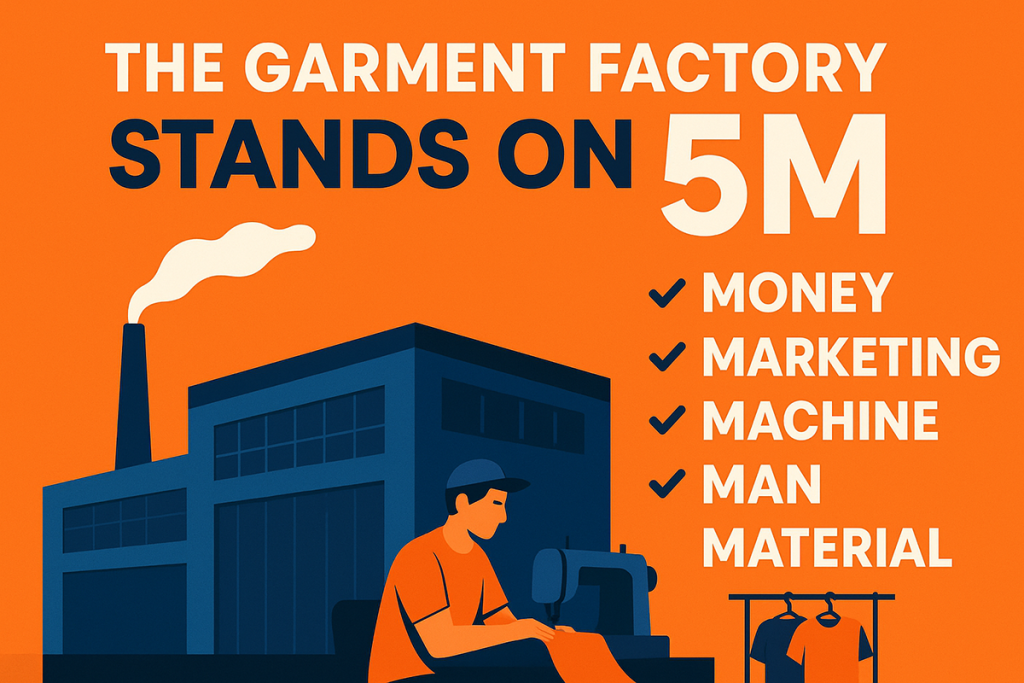
The Garment Factory Stands on 5M: The Real Pillars of Success
The garment industry is not just about sewing machines or piles of fabric. Running a factory is like running a living system — everything must connect and work together. If we look closely, a garment factory actually stands on 5 powerful pillars: Money, Marketing, Machine, Man, and Material.
Without these 5M, no factory can survive. Let’s break it down in a simple and practical way.
1. Money – nothing moves without it
The first “M” is Money.
- You need money to build the factory.
- You need money to buy machines.
- You need money to pay salaries.
- You need money to buy fabrics and trims.
In short: No money = no production.
That’s why proper budgeting, costing, and financial planning are the backbone of the garment industry. Many factories depend on bank loans, buyer advances, and working capital to keep the cycle running.
👉 Think of money as the blood of the factory. Without cash flow, everything stops.
2. Marketing – The key to bringing orders
Even if you have money, machines, and workers — without marketing, your factory will stay empty.
Marketing in garments means:
- Building trust with international buyers.
- Attending fairs and exhibitions.
- Keeping strong relationships through merchandising.
- Using digital platforms (like LinkedIn, websites, social media) to reach buyers.
👉 In simple words: Marketing is the door to new orders.
Factories that focus on marketing never wait for buyers to come — they go out, tell their story, and bring the buyers in.
3. Machine – the engine of production
Garment factories run on machines. From cutting fabric to stitching, embroidery, washing, and finishing — machines power everything.
But not just any machines. To survive in today’s fast fashion world, factories must use modern, high-tech machines.
Examples:
- CAD systems for fast pattern-making.
- Automatic cutting machines to save fabric and reduce mistakes.
- ERP systems to track production in real-time.
- Sewing automation for speed and consistency.
👉 Remember this simple rule: Good machines = good production.
4. Man – the human backbone
Machines alone cannot run a factory. You need people. This is the fourth “M” — Man.
- Operators stitch the garments.
- Supervisors maintain workflow.
- Merchandisers handle buyers.
- Managers keep the entire system alive.
Bangladesh, for example, has over 4 million workers in its garment sector — most of them women. Their skill and dedication make the industry strong.
👉 Manpower is not just labor. It’s the heart, soul, and brain of the garment industry.
5. Material – the raw foundation
Finally, we come to Material — the starting point of everything.
No matter how skilled your workers are or how advanced your machines are, without good materials you cannot deliver quality garments.
Materials include:
- Fabrics (cotton, polyester, blends, etc.)
- Trims (buttons, zippers, labels)
- Packaging items
If the material is poor, the whole shipment can get rejected. That means loss of money, loss of time, and loss of buyer trust.
👉 In simple terms: Wrong material = wrong product.
Why the 5M are so important
Think of a chair with 5 legs. If one leg breaks, the chair cannot stand. The same goes for the garment industry.
- Without Money, production cannot start.
- Without Marketing, orders will not come.
- Without Machines, production cannot run.
- Without Man, nothing will move.
- Without Material, there is no product.
👉 All 5M must work together for the factory to succeed.
The future of 5M in garment factories
The world of garments is changing fast. Here’s how the 5M will look in the future:
- Money → Digital finance, green investment, smarter budgeting.
- Marketing → Online sourcing platforms, virtual showrooms, AI-based buyer connection.
- Machine → Robotics, 3D printing, fully automated factories.
- Man → More skilled workers, training, better worker rights and safety.
- Material → Sustainable fabrics, organic cotton, recycled yarns.
Factories that adapt to these changes will lead the global market. Others will be left behind.
Conclusion
Running a garment factory is not just about fabric and stitching. It is about balance. And that balance depends on the 5M — Money, Marketing, Machine, Man, and Material.
👉 The garment factory stands on 5M. That’s the simple truth.
If these five elements are strong, the factory will survive, grow, and succeed in the global market. If even one fails, the entire system can collapse.
So, the next time you wear a T-shirt or jeans, remember: behind that simple piece of clothing lies the invisible power of 5M.
💬 0 Comments
💭 Share your thoughts