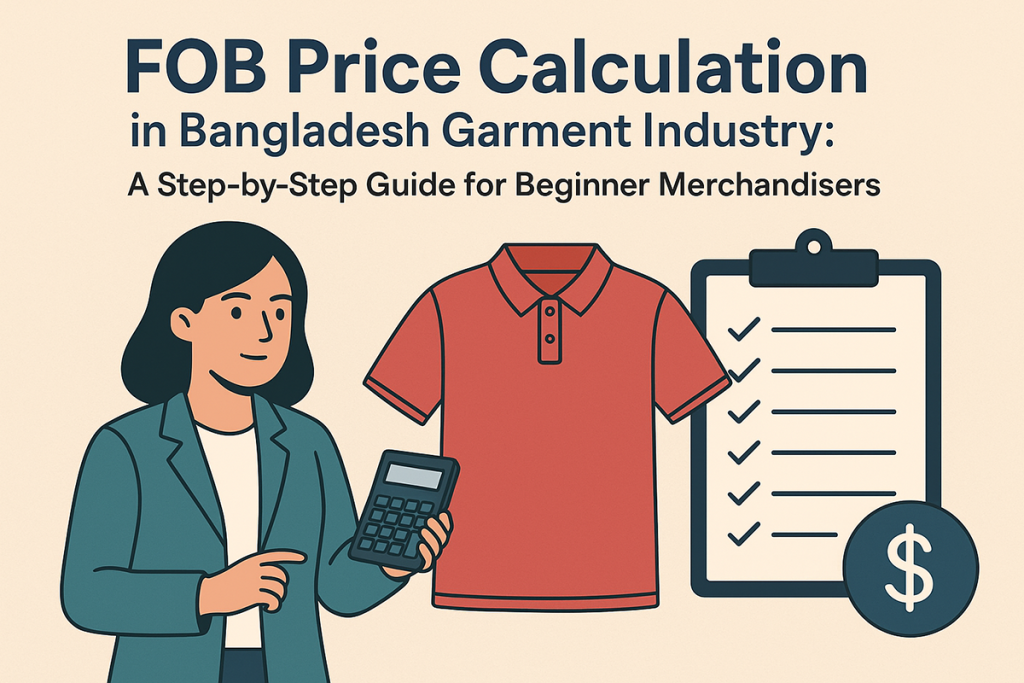
FOB Price Calculation in Bangladesh Garment Industry: A Step-by-Step Guide for Beginner Merchandisers.
The garment industry in Bangladesh is one of the largest in the world, and FOB price calculation is the backbone of every successful order. If you are a beginner merchandiser, understanding how to calculate FOB (Free on Board) price is not just important—it’s the first step to becoming a confident professional in this field.
In this article, I’ll walk you through the step-by-step process of FOB price calculation, explain the hidden costs, and share practical tips that real merchandisers use every day.
What is FOB price in garment industry?
FOB stands for Free on Board. In simple words, FOB price means the cost of goods including everything up to loading the shipment on the ship at the port of export (like Chittagong or Mongla in Bangladesh).
It includes:
- Cost of fabrics
- Accessories and trims
- Washing, printing, embroidery, finishing
- CM (Cutting & Making charges)
- Overheads and profit margin
- Transportation up to port
👉 Anything that happens after shipping (like freight, insurance, customs in buyer’s country) is not part of FOB price.
Why FOB price calculation matters for merchandisers.
For a merchandiser, FOB price is not just a number. It is:
- The basis of buyer negotiations – Too high, and you lose the order. Too low, and the factory loses money.
- The foundation of costing and profit planning.
- The tool to avoid mistakes. If you miss even a small cost, you may face loss at shipment stage.
That’s why a beginner merchandiser must learn FOB calculation with attention to detail.
Step-by-step guide to FOB price calculation.
Let’s go step by step, in a simple and practical way.
Step 1: Fabric Costing
Fabric is the heart of apparel costing. For most garments, fabric accounts for 50–70% of total FOB.
- Calculate fabric consumption per garment (with wastage).
- Multiply consumption by fabric price per yard or per kg.
Example:
- Fabric price = $5.00 per kg
- Consumption = 0.35 kgs
- Wastage = 5%
- Final consumption = 0.35 yards × $5.00 = $1.75
Step 2: Accessories and Trims
Add all the small but important items:
- Sewing thread, buttons, zippers
- Labels, tags, poly bags, cartons
👉 Even though small, missing trims can create loss in costing.
Step 3: Processing Costs (Printing, Embroidery, Washing)
Every garment may require different value-addition.
- Printing cost = per piece
- Embroidery = per stitch / per logo
- Washing (like stone wash, enzyme wash) = per piece
Add them separately for clarity.
Step 4: CM (Cutting to Finising) Charges
This is the labour cost for cutting, sewing, finishing. Factories usually give CM rate per piece.
- Example: CM = $0.55 per piece
Step 5: Overhead Expenses
Overhead includes admin, utilities, compliance, sample costs, finance charges. Normally 10–15% of FOB is considered as overhead.
Step 6: Profit Margin
No business runs without profit. A standard margin is 8–12%, depending on order and buyer.
Step 7: Add Transportation to Port
Finally, add cost of local transport from factory to port, port handling, documentation.
FOB price calculation example.
Let’s calculate for a basic polo shirt:
| Cost Head | Value (USD) |
|---|---|
| Fabric | $1.75 |
| Trims & Accessories | $0.35 |
| Printing/ Embo | $0.40 |
| CM (Cutting to Finising) | $0.55 |
| Overheads (10%) | $0.30 |
| Profit Margin (10%) | $0.30 |
| Local Transport & Port Charges | $0.30 |
| Total FOB Price | $3.95 |
👉 So, the FOB price for this polo shirt is $3.95 per piece.
Common mistakes beginner merchandisers make.
- Ignoring wastage percentage – Always add 3–5% for fabric wastage.
- Forgetting hidden trims – Like hangers, tissue paper, barcode stickers.
- Underestimating overheads – Every small cost matters.
- Not adding buffer in profit margin – Buyers always negotiate, so keep room.
- Mixing FOB with CIF – Remember, FOB ends at port of shipment.
Practical tips for beginner merchandisers.
- Always double check fabric consumption with a CAD marker or sample.
- Use an Excel costing sheet for transparency.
- Communicate with suppliers for updated prices of fabric and trims.
- Compare with last season’s costing to avoid mistakes.
- Keep records – buyers often ask for costing breakdown.
Final Thoughts
FOB price calculation may look complicated at first, but with practice it becomes a natural skill. As a beginner merchandiser in the Bangladesh garment industry, mastering FOB calculation will give you confidence in buyer meetings, better control over orders, and a clear picture of profit and risk.
Remember: accurate costing = successful merchandising.
💬 0 Comments
💭 Share your thoughts