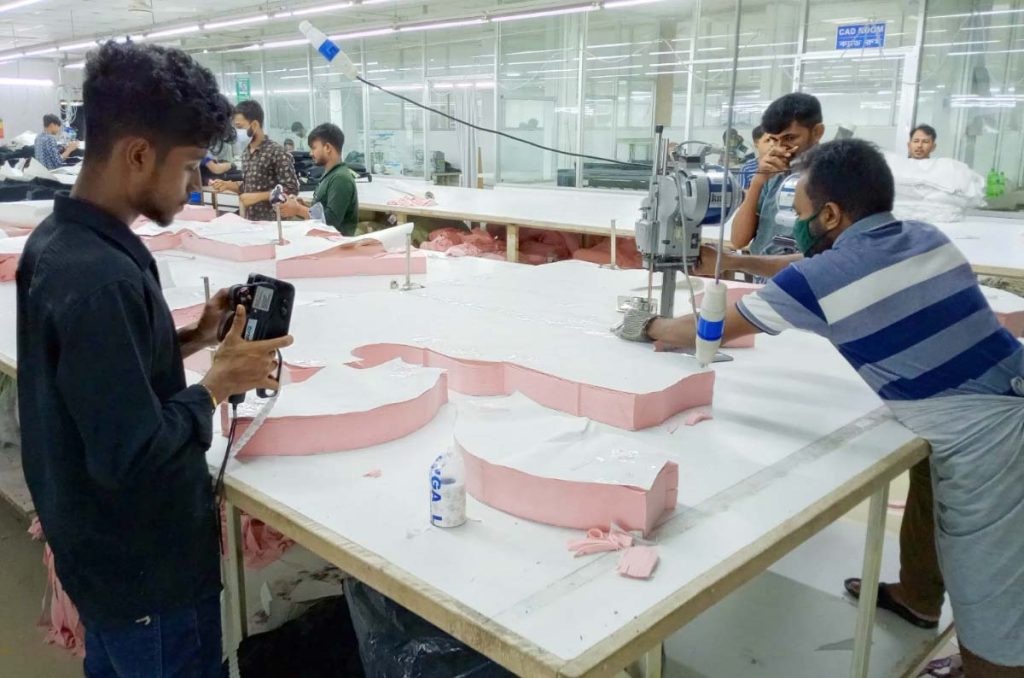
Cutting section in a garment factory – the first step in making a garment
Let’s begin the story
When you wear a T-shirt, have you ever thought — where did it all begin?
It started in a cutting section inside a garments factory.
This is the first and most important step in making clothes. Here, big rolls of fabric are carefully cut into small parts — like the front, back, sleeves, and neck.
It’s like cutting pieces of a puzzle before putting it together.
What is the cutting section?
The cutting section is the place where fabric is cut based on the size and shape of the clothes.
Example:
If you are making 1000 T-shirts, the cutting section will cut 1000 front parts, 1000 back parts, 2000 sleeves, etc.
It’s the first step after receiving fabric from the store.
Why cutting section is important
- If cutting is wrong, stitching will not be correct.
- If sizes don’t match, the whole garment will be rejected.
- Cutting affects the quality, fitting, and cost of the final product.
That’s why factories always give extra care to the cutting floor.
Simple step-by-step process of cutting section
Let’s look at the real work, step by step.
Step 1: Fabric relaxing
When fabric comes to the factory, it is tight and stretched.
What they do:
Lay the fabric on racks for 12–24 hours. This helps the fabric relax.
Why?
If not relaxed, the size may shrink later. This will cause fitting problems.
Step 2: Fabric Inspection (4-Point Check)
Before cutting, fabric must be checked properly. This step is very important to find any problems like:
- Holes
- Stains
- Color shading
- Yarn defects
- Printing problems ( If all over print fabric (AOP))
Factories usually use the 4-Point System for checking. Here’s how it works:
| Defect Size | Points Given |
|---|---|
| 0 – 3 inches | 1 point |
| 3 – 6 inches | 2 points |
| 6 – 9 inches | 3 points |
| More than 9 inches | 4 points |
Each fabric roll is checked and scored. If the points are too high, the fabric is rejected or used carefully.
Why is this step needed?
If bad fabric is cut and stitched, the final garment will be rejected by buyers. That means loss.
Pro Tip: A trained fabric checker can save lakhs of Taka by catching small defects early.
Step 3: Laying the fabric.
After fabric inspection (4-point test), the fabric is laid for cutting.
What they do:
They spread layers of fabric (50-100) on a long table.
How?
By hand or by machine (called a fabric spreader).
Goal:
No wrinkles, no tension — flat and clean layers.
Step 3: Marker making
After laying out the fabric, you have to cut it with a marker.
What is a marker?
It’s a paper showing all parts of the garment — placed on top of the fabric.
Why?
To cut fabric smartly, reduce waste, and save money.
Like a blueprint before building a house.
Step 4: Cutting
Now the real cutting starts.
The cutter follows the marker and cuts all the layers using:
- Straight knife
- Round knife
- Band knife
- Auto cutter (in modern factories)
The cutter must be focused. One small mistake can waste the whole layer.
Step 5: Numbering
Each piece is given a number (1, 2, 3…).
This helps match parts together during stitching.
Without numbering, wrong size mixing can happen.
Step 6: Bundling and sending to sewing
After cutting and numbering, the pieces are tied into bundles.
Then, these bundles go to the sewing section, where they turn into full garments.
Machines used in cutting section
| Machine Name | Use |
|---|---|
| Straight Knife | For thick fabric cutting |
| Round Knife | For soft fabrics and curves |
| Band Knife | For clean and detailed cutting |
| Fabric Spreader | For laying fabric smoothly |
| Auto Cutter | Fast and accurate cutting |
Common Problems in Cutting Section
| Problem | Result |
|---|---|
| Wrong measurement | Wrong size garments |
| Blade not sharp | Bad edges, quality issues |
| Skipping relaxing | Garment shrinks after washing |
| Poor marker | Extra fabric waste |
Solution:
Follow process. Use good tools. Train workers. Double-check.
People who work in cutting section
| Job Role | What They Do |
|---|---|
| Spreader | Lays fabric |
| Marker Man | Makes the layout on fabric |
| Cutter | Cuts the fabric |
| Numbering Man | Puts size numbers on pieces |
| Supervisor | Checks all steps and quality |
All team members must work together like a football team.
Why It is called the “Heart of the Factory”
If cutting is perfect:
- Sewing is easy
- Less rejection
- Buyer is happy
- Factory makes profit
If cutting is wrong:
- Big loss
- Delay in shipment
- Poor quality clothes
That’s why good factories always respect the cutting team.
Final thoughts
The cutting section in garments factory is the real starting point of your clothes. It’s not a glamorous place — but it is powerful.
If you want to start a factory or work in garments, learn cutting. It’s the first step to quality.
💬 0 Comments
💭 Share your thoughts