What is the AQL in the Apparel Industry? for Beginner Merchandisers.
If you are new to the apparel industry, one of the terms you will often hear is AQL. At first, it may sound complicated, but don’t worry. In this article, we will break it down step by step in an easy and practical way so that any beginner merchandiser can understand it.
Introduction: Why quality matters in apparel industry.
When a buyer places an order with a garment factory, they expect quality. No matter how good the price or style is, if the product quality fails, the business relationship suffers. That’s why every factory and merchandiser follows strict quality control systems.
Here comes the word AQL—a universal standard that helps to check and maintain garment quality before shipping.
What is AQL?
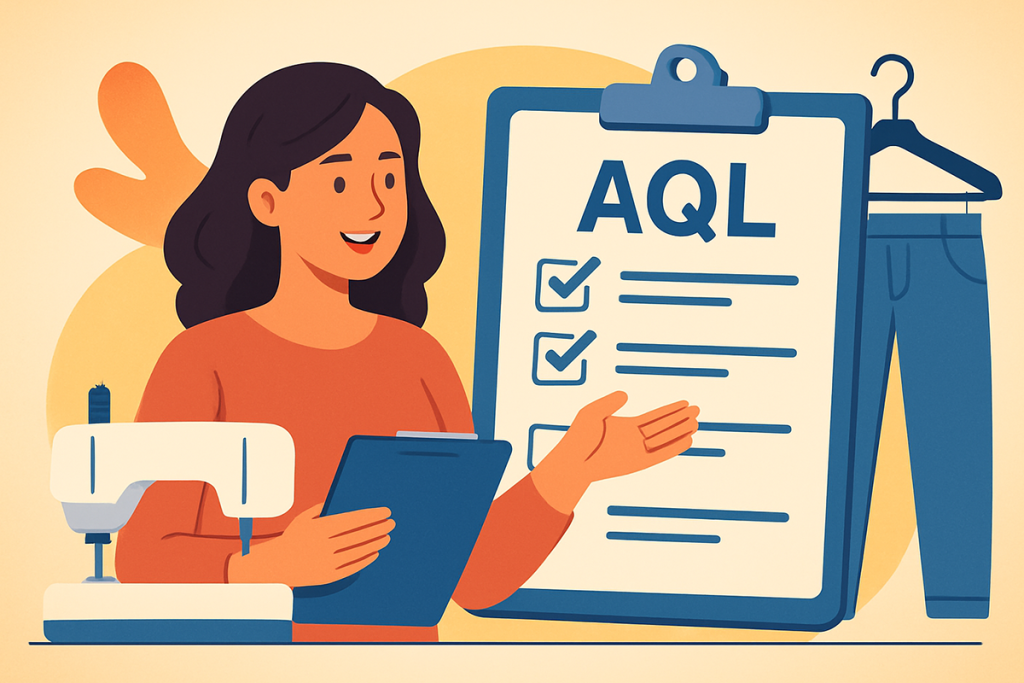
AQL means “Acceptable Quality Level.”
In simple words, it is the quality standard used by buyers and factories to decide how many defects are allowed in a shipment of garments.
No factory in the world can make 100% perfect products. Small defects may happen during production—like loose threads, skipped stitches, or shade variations. AQL sets a limit on how many of these defects are acceptable. If the number of defects is within the limit, the order passes. If not, it fails.
Why AQL is important for beginner merchandisers.
As a merchandiser, you are the bridge between the buyer and the factory. You need to understand AQL because:
- Buyers will ask you about inspection levels and AQL standards.
- You need to communicate clearly with the quality team.
- It helps you manage buyer trust by ensuring shipment quality.
- It protects your factory from rejection and financial loss.
Without AQL knowledge, you may struggle to handle quality discussions confidently.
How AQL works in the apparel industry.
Let’s make it simple with an example:
Suppose a buyer orders 10,000 T-shirts from your factory. It is impossible to check all 10,000 pieces one by one. Instead, quality inspectors will select a sample size from the order.
The number of pieces selected depends on the AQL standard chart (ISO 2859 / MIL-STD-105E). For example:
- If the order is 10,000 pcs, the chart may suggest checking 200 pcs.
- Now, according to AQL 2.5, the maximum defective pieces allowed might be 10 pcs.
- If defects are within 10 pcs, the lot passes. If defects exceed 10, the lot fails.
So, AQL works like a guideline that balances quality and practicality.
Common AQL levels in apparel industry.
Buyers usually set different AQL levels for different types of defects. The three main categories are:
- Critical Defects (AQL 0.0%)
- These are defects that make the product unsafe or unusable.
- Example: A broken needle found inside a garment, wrong size label, or missing parts.
- Tolerance: Zero. Not acceptable.
- Major Defects (AQL 2.5%)
- These are defects that reduce the product’s value or function, and a customer will likely return it.
- Example: Open seam, wrong stitching, large stains, or incorrect measurements.
- Minor Defects (AQL 4.0% or 4.5%)
- Small issues that don’t affect product use but may reduce appearance.
- Example: Loose threads, small oil marks, slight shade variation.
AQL chart: The inspection table.
The AQL system uses a statistical chart. Beginner merchandisers don’t need to memorize the full chart, but you should know how it works.
- The lot size (order quantity) decides the sample size.
- Then, according to the buyer’s required AQL, you can calculate how many defective pieces are allowed.
For example:
- Lot size: 5,000 pcs.
- Sample size (per chart): 125 pcs.
- AQL 2.5 = Acceptable defective pcs: 7.
- If defects ≤ 7 → Pass. If defects > 7 → Fail.
Role of merchandisers in AQL inspections.
As a beginner merchandiser, your responsibilities include:
- Understanding Buyer’s Requirement
- Always check which AQL standard the buyer follows. Some follow AQL 2.5/4.0, others may set stricter levels.
- Preparing the Factory
- Work with production and quality teams to minimize defects before inspection.
- Ensure proper in-line checks and final audits.
- Communicating with Inspectors
- During third-party inspections, you may need to explain production processes and solve disputes.
- Reporting to Buyer
- You will often prepare reports highlighting AQL results for buyer approval.
Real-Life example: AQL in action
Imagine you are working for a buying house. Your buyer from Europe orders 5,000 denim jeans.
- Buyer’s AQL requirement: 2.5 for Major, 4.0 for Minor.
- Sample size (per AQL chart): 200 pcs.
- Inspector checks 200 pcs and finds:
- Major defects: 4 pcs.
- Minor defects: 6 pcs.
Result:
- For AQL 2.5, maximum allowed majors = 10. (4 < 10 → Pass)
- For AQL 4.0, maximum allowed minors = 14. (6 < 14 → Pass)
Therefore, the shipment passes and can be shipped to the buyer.
Tips for beginner merchandisers on AQL.
- Always read the buyer manual. Each buyer has their own AQL guidelines.
- Learn to use the AQL chart for different lot sizes.
- Never hide defects—be transparent with buyers.
- Maintain in-line inspections during production to reduce final rejections.
- Remember: Prevention is better than correction.
Conclusion
So, what is the AQL in the apparel industry?
It is the Acceptable Quality Level, a statistical method used to decide how many defects are allowed in a shipment.
For beginner merchandisers, AQL is not just a number—it’s the language of quality. Understanding AQL helps you communicate better with buyers, coordinate with factories, and ensure successful shipments.
The more you practice, the more confident you will become in handling quality standards. And as you grow in your career, AQL knowledge will always be one of your strongest tools.
💬 1 Comments
💭 Share your thoughts