
Yarn Count Formula: How to Calculate Yarn Count from GSM.
In the textile and apparel industry, understanding yarn count is essential for fabric departments, and merchandisers. Yarn count determines the fineness or coarseness of yarn, which directly affects fabric weight, GSM (grams per square meter), and overall garment quality.
This article explains the yarn count formula, shows how to calculate yarn count from GSM, and provides examples and charts to make it easier for beginners.
What is yarn count?
Yarn count is a numerical expression that defines the thickness or fineness of yarn. In simple words, it tells you how fine or coarse a yarn is.
- Higher yarn count (36s, 40s, 50s, 60s) → finer yarn
- Lower yarn count (20s, 24s, 26s) → coarser yarn
For example, a 40s yarn is thinner and used in lightweight fabrics (like t-shirts), while a 20s yarn is thicker and used in heavier fabrics (like sweatshirts).
Yarn count formula (practical for merchandisers)
For quick merchandiser-level calculations, the formula is:
Yarn count is always an even number. Adjust the result by ±1 to maintain evenness.
- Single Jersey Yarn Count = 4320 ÷ GSM
- Piqué Yarn Count = 5200 ÷ GSM
- Interlock Yarn Count = 7200 ÷ GSM
- Terry Yarn Count = 6240 ÷ GSM
- Lacost Yarn Count = 5500 ÷ GSM
Example Calculations
Yarn count is always an even number. Adjust the result by ±1 to maintain evenness.
Example 1: Single Jersey Fabric
If GSM = 160 →
✅ Yarn count ≈ 26s or 28s
Example 3: Piqué Fabric
If GSM = 200 →
Yarn Count = 5200 ÷ 200 = 26s
✅ Yarn count ≈ 26s
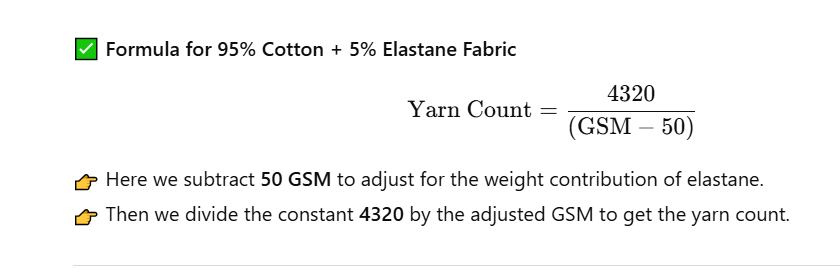
When working with cotton + elastane blends, elastane adds extra GSM but doesn’t contribute to yarn count in the same way as cotton. That’s why we use the adjusted formula (GSM – 50) to get a more accurate yarn count.
Why merchandisers need this formula
- Easy Fabric Estimation – Quick way to predict yarn count from GSM.
- Costing & Consumption – Helps in yarn requirement calculation.
- Buyer Communication – Supports GSM vs yarn count discussions with buyers.
- Practical Tool – Saves time when lab testing is not available.
Limitations to remember
- GSM doesn’t only depend on yarn count; stitch length, machine gauge, and finishing also affect it.
- Always use a GSM cutter for accurate measurement.
- Cross-check important orders with lab reports before confirmation.
Practical tips for merchandisers
- Always confirm fabric width and stitch length before finalizing yarn count.
- Use a GSM cutter and balance to measure GSM accurately.
- Keep a yarn count chart for quick reference in meetings with buyers.
- For precision, cross-check with lab testing (yarn CSP, twist, strength).
Conclusion
For merchandisers, understanding Fabric GSM vs Yarn Count is a must-have skill. Using simple formulas:
- Single Jersey – 4320 ÷ GSM = Yarn Count
- Piqué = 5200 ÷ GSM = Yarn Count
👉 You can quickly estimate yarn count and make faster decisions in costing and production.
Mastering this formula will give you confidence in meetings, help in buyer discussions, and improve your efficiency as a merchandiser.
💬 0 Comments
💭 Share your thoughts